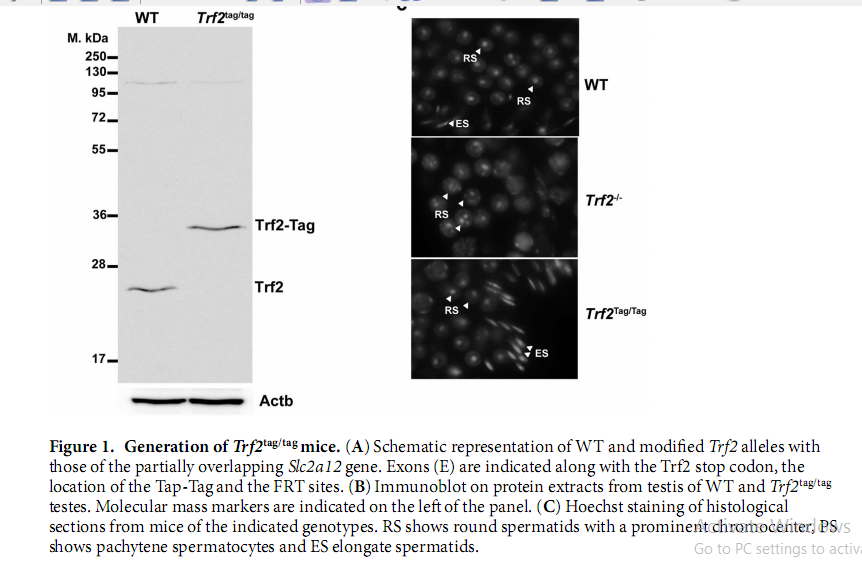
1. Abstract Mammalian genomes encode two genes related to the TATA-box binding protein (TBP), TBP-related factors 2 and 3 (TRF2 and TRF3). Male Trf2(-/-) mice are sterile and characterized by arrested spermatogenesis at ... Mammalian genomes encode two genes related to the TATA-box binding protein (TBP), TBP-related factors 2 and 3 (TRF2 and TRF3). Male Trf2(-/-) mice are sterile and characterized by arrested spermatogenesis at the transition from late haploid spermatids to early elongating spermatids. Despite this characterization, the molecular function of murine Trf2 remains poorly characterized and no direct evidence exists to show that it acts as a bona fide chromatin-bound transcription factor. We show here that Trf2 forms a stable complex with TFIIA or the testis expressed paralogue ALF chaperoned in the cytoplasm by heat shock proteins. We demonstrate for the first time that Trf2 is recruited to active haploid cell promoters together with Tbp, Taf7l and RNA polymerase II. RNA-seq analysis identifies a set of genes activated in haploid spermatids during the first wave of spermatogenesis whose expression is down-regulated by Trf2 inactivation. We therefore propose that Trf2 is recruited to the preinitiation complex as a testis-specific subunit of TFIIA/ALF that cooperates with Tbp and Taf7l to promote haploid cell gene expression.
PMID: [27576952]
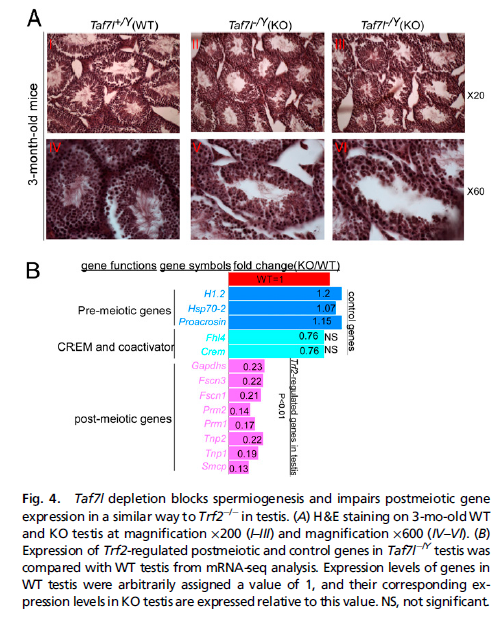
2. Abstract TATA-binding protein (TBP)-associated factor 7l (Taf7l; a paralogue of Taf7) and TBP-related factor 2 (Trf2) are components of the core promoter complex required for gene/tissue-specific transcription of protein-coding genes by RNA polymerase ... TATA-binding protein (TBP)-associated factor 7l (Taf7l; a paralogue of Taf7) and TBP-related factor 2 (Trf2) are components of the core promoter complex required for gene/tissue-specific transcription of protein-coding genes by RNA polymerase II. Previous studies reported that Taf7l knockout (KO) mice exhibit structurally abnormal sperm, reduced sperm count, weakened motility, and compromised fertility. Here we find that continued backcrossing of Taf7l(-/Y) mice from N5 to N9 produced KO males that are essentially sterile. Genome-wide expression profiling by mRNA-sequencing analysis of wild-type (WT) and Taf7l(-/Y) (KO) testes revealed that Taf7l ablation impairs the expression of many postmeiotic spermatogenic-specific as well as metabolic genes. Importantly, histological analysis of testes revealed that Taf7l(-/Y) mice develop postmeiotic arrest at the first stage of spermiogenesis, phenotypically similar to Trf2(-/-) mice, but distinct from Taf4b(-/-) mice. Indeed, we find that Taf7l and Trf2 coregulate postmeiotic genes, but none of Taf4b-regulated germ stem cell genes in testes. Genome-wide ChIP-sequencing studies indicate that TAF7L binds to promoters of activated postmeiotic genes in testis. Moreover, biochemical studies show that TAF7L associates with TRF2 both in vitro and in testis, suggesting that TAF7L likely cooperates directly with TRF2 at promoters of a subset of postmeiotic genes to regulate spermiogenesis. Our findings thus provide a previously undescribed mechanism for cell-type-specific transcriptional control involving an interaction between a "nonprototypic" core promoter recognition factor (Trf2) and an orphan TAF subunit (Taf7l) in mammalian testis-specific gene transcription.
PMID: [24082143]
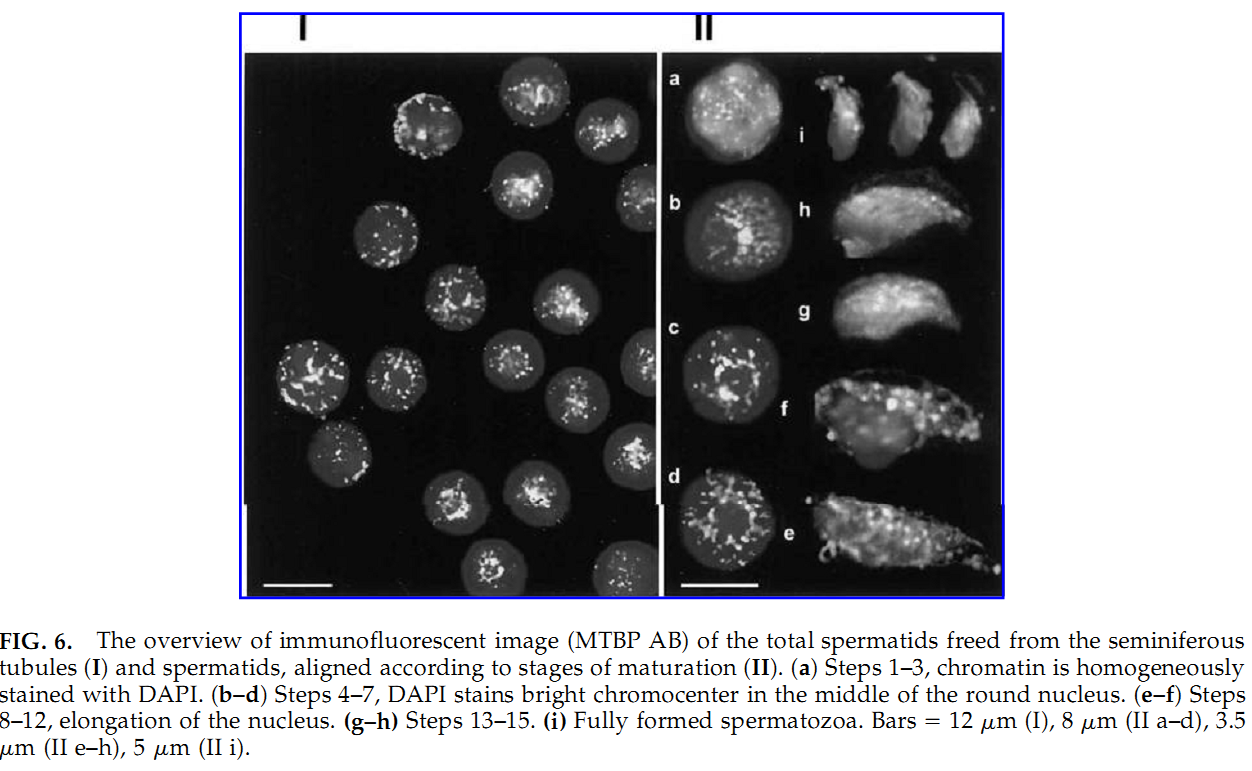
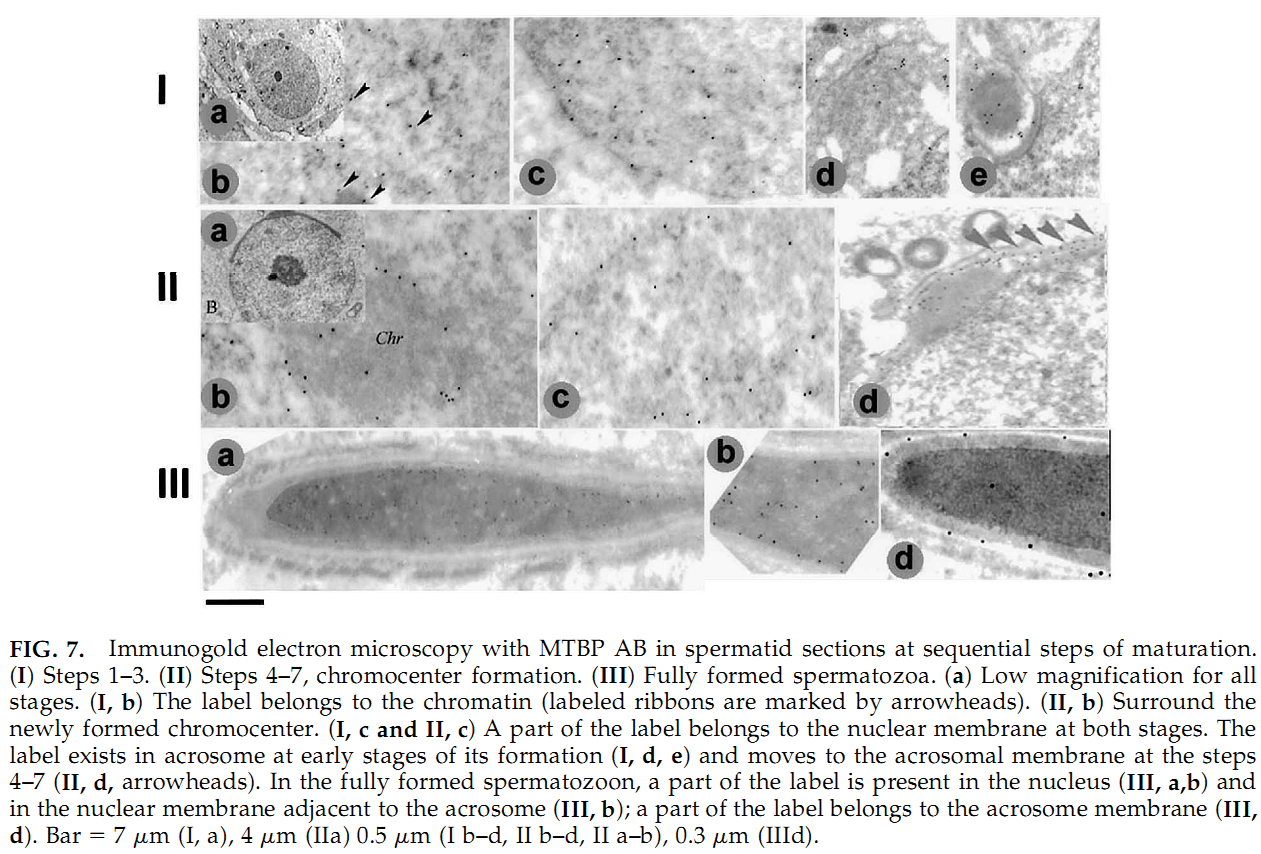
3. Abstract Observations of the organization and distribution of telomeres (Tel) in somatic tissues still remain controversial. The Tel topography revealed by modern microscopy shows them to be associated with the nuclear envelope (NE) ... Observations of the organization and distribution of telomeres (Tel) in somatic tissues still remain controversial. The Tel topography revealed by modern microscopy shows them to be associated with the nuclear envelope (NE) in a wide variety of eukaryotic cells, although not at the Rabl orientation (peripheral position at one pole of the nucleus at prophase). We used two cell types that have different nuclear architectures. The cell line L929 shows lack of any rigid Tel architecture in the nucleus. In contrast, spermatozoa have a precise architecture established during spermiogenesis. We observed Tel and membrane Tel binding protein (MTBP/TRF2) position by immunoFISH in L929 cells and by immunofluorescence and immunogold electron microscopy, using antibodies against Membrane Tel Binding Protein (MTBP/TRF2), during different stages of spermiogenesis. At all stages of the L929 cell cycle, MTBP/TRF2 is co-localized with Tel. The only Tel order found in this cell type is similar to the Rabl-orientation, probably due to fast divisions. In the mouse pachytene spermatocytes, the membrane structures abut on the synaptonemal complex (SC) attachment sites contain MTBP/TRF2. In fully formed spermatozoa and during spermiogenesis, apart from the expected MTBP/TRF2 position at the nuclear periphery, MTBP/TRF2 unexpectedly localized at the acrosomal membrane that is adjacent to the nucleus. The difference in the MTBP/TRF2 distribution in the oocyte and spermatozoa leads to the suggestion that the MTBP/TRF2 location might reflect preparation for fertilization events. The Tel distribution is not static in cultured cells throughout the cell cycle or during spermatogenesis. When the Tel are attached to the NE, as during SC formation, MTBP/TRF2 is the member of the protein complex, which appears to be responsible for this attachment.
PMID: [14614800]
4. Abstract The gene encoding TATA-binding protein-related factor 2 (TRF2/TLF/TLP/TRP), essential for the progress of spermiogenesis, is abundantly expressed in mammalian testis. A sequence database search revealed that mouse TRF2 is encoded by two ... The gene encoding TATA-binding protein-related factor 2 (TRF2/TLF/TLP/TRP), essential for the progress of spermiogenesis, is abundantly expressed in mammalian testis. A sequence database search revealed that mouse TRF2 is encoded by two mRNAs containing the same protein-coding region and different 5'-untranslated regions. Northern blot analysis using DNA probes specific for the 5'-untranslated regions demonstrated that these two mRNAs are distinguished from each other by the expression patterns
PMID: [14967955]
5. Abstract The location of centromeric protein CENP-B and telomeric protein TRF2/MTBP in the mouse spermatogenic line has been studied using indirect immunofluorescent and immunoelectron microscopy. CENP-B localized to the heterochromatic parts of the ... The location of centromeric protein CENP-B and telomeric protein TRF2/MTBP in the mouse spermatogenic line has been studied using indirect immunofluorescent and immunoelectron microscopy. CENP-B localized to the heterochromatic parts of the nuclei at meiotic stages. A clearly distinct chromocenter forms in the nucleus at stages 3-4 of spermatid maturation; CENP-B localizes in it and in the area adjacent to the future acrosome. CENP-B localization in the subacrosomal area and in the chromocenters' periphery demonstrates that centromeres are organized in two groups in mouse spermatozoa, unlike human centromeres. TRF2/MTBP concentrates around the forming chromocenter at spermiogenesis early stages. The TRF2/MTBP main signal migrates into the area of acrosomal membrane at the course of spermatozoon maturation. TRF2/MTBP never localizes inside the synaptonemal complex but can be found in the areas where the synaptonemal complex attaches to the nuclear envelope. At the pachytene and diplotene stages when chromosomes separate from the nuclear envelope, some amount of the protein remains bound to the nuclear membrane while the other part reveals itself in chromosomes. TRF2/MTBP accumulates in the future acrosome from the very beginning of its formation. In the mature spermatozoon TRF2/MTBP decorates the acrosomal membrane as well as spreads in condensed chromatin.
PMID: [17353134]
6. Abstract The differentiation process of spermatogenesis is based on a finely timed program of transcriptional regulation and chromatin remodeling. Male germ cells utilize specialized transcription complexes, which display specific differences in the ... The differentiation process of spermatogenesis is based on a finely timed program of transcriptional regulation and chromatin remodeling. Male germ cells utilize specialized transcription complexes, which display specific differences in the components of the general transcription machinery. The TATA-binding protein (TBP)-related protein 2 (TRF2) is essential for progression in spermiogenesis and for the structuring of the chromocenter, an heterochromatic structure unique of round spermatids. To decipher the molecular pathways of TRF2 action, we have searched for TRF2 partners in male germ cells. We have isolated TIPT (TRF2 interacting protein in testis), a relatively small protein that associates with TRF2 with affinity comparable to TFIIA. TIPT is uniquely expressed in testis, with a developmental pattern that temporally parallels the one of TRF2. Importantly, TIPT interacts also with HP1 proteins, thereby establishing an intriguing link between transcription and chromatin condensation. Association of TIPT with either TRF2 or HP1 occurs through the C-terminal domain in a mutually exclusive manner. These findings indicate that TIPT could contribute to the precise timing of the molecular events in male germ cells, specifically by linking transcription to chromatin remodeling in round spermatids.
PMID: [18418073]
Martianov, I., Velt, A., Davidson, G., Choukrallah, M. A. and Davidson, I. (2016) TRF2 is recruited to the pre-initiation complex as a testis-specific subunit of TFIIA/ALF to promote haploid cell gene expression. Sci Rep 6(): 32069. PMID: [27576952]
Zhou, H., Grubisic, I., Zheng, K., He, Y., Wang, P. J., Kaplan, T. and Tjian, R. (2013) Taf7l cooperates with Trf2 to regulate spermiogenesis. Proc Natl Acad Sci U S A 110(42): 16886-91. PMID: [24082143]
A. V. Dolnik, I. S. Kuznetsova, A. P. Voronin and O. I. Podgornaya (2003) Telomere-binding TRF2/MTBP localization during mouse spermatogenesis and cell cycle of the mouse cells L929. J Anti Aging Med 6(2): 107-21. PMID: [14614800]
A. V. Dolnik, I. S. Kuznetsova, A. P. Voronin and O. I. Podgornaya (2003) Telomere-binding TRF2/MTBP localization during mouse spermatogenesis and cell cycle of the mouse cells L929. J Anti Aging Med 6(2): 107-21. PMID: [14614800]
TATA-box binding protein (TBP), TBP-related factors 2 Trf2 forms a stable complex with TFIIA or the testis expressed paralogue ALF chaperoned in the cytoplasm by heat shock proteins. Trf2 is recruited to the preinitiation complex as a testis-specific subunit of TFIIA/ALF that cooperates with Tbp and Taf7l to promote haploid cell gene expression.|TBP-related factor 2 (Trf2) is the components of the core promoter complex required for gene/tissue-specific transcription of protein-coding genes by RNA polymerase II. The core promoter recognition factor Trf2 is highly expressed in a finely regulated pattern in the mouse testis during spermatogenesis, and mice lacking Trf2 are viable but sterile due to a complete arrest of late spermiogenesis with largely normal spermatogonia and spermatocyte
ReactomeID: R-MMU-2559586 DNA Damage/Telomere Stress Induced Senescence