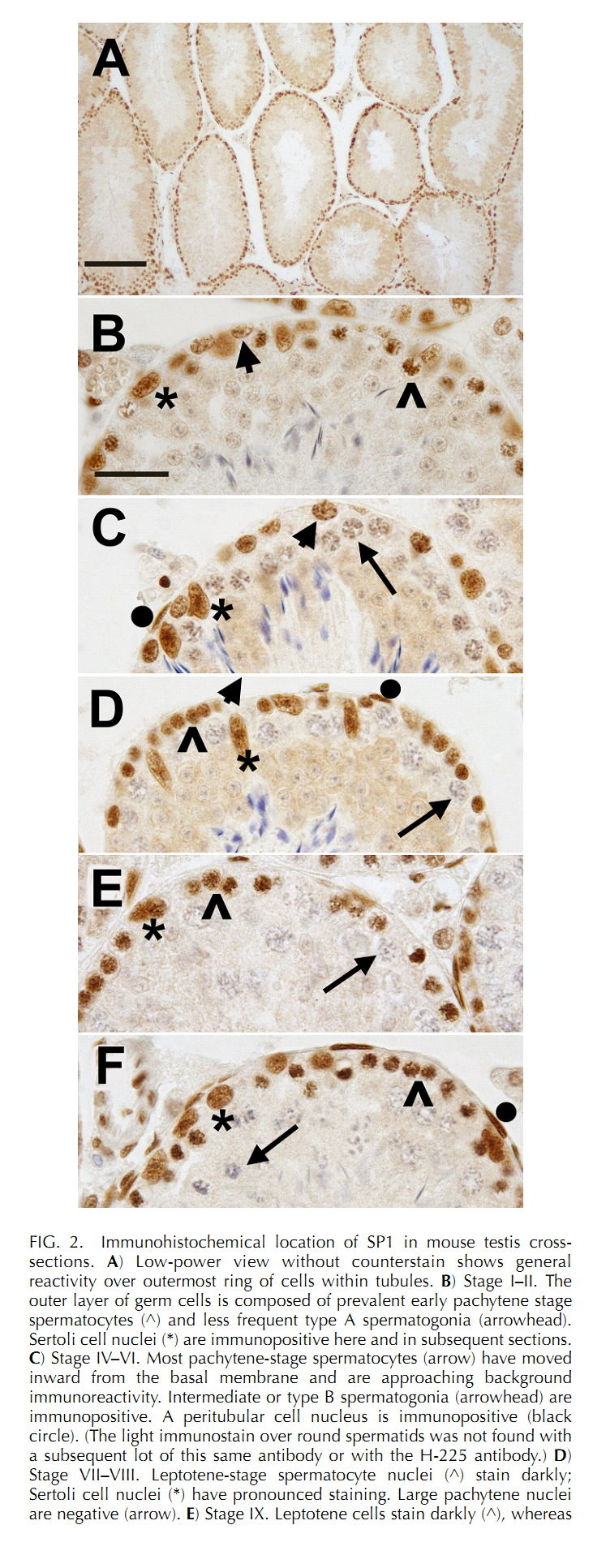
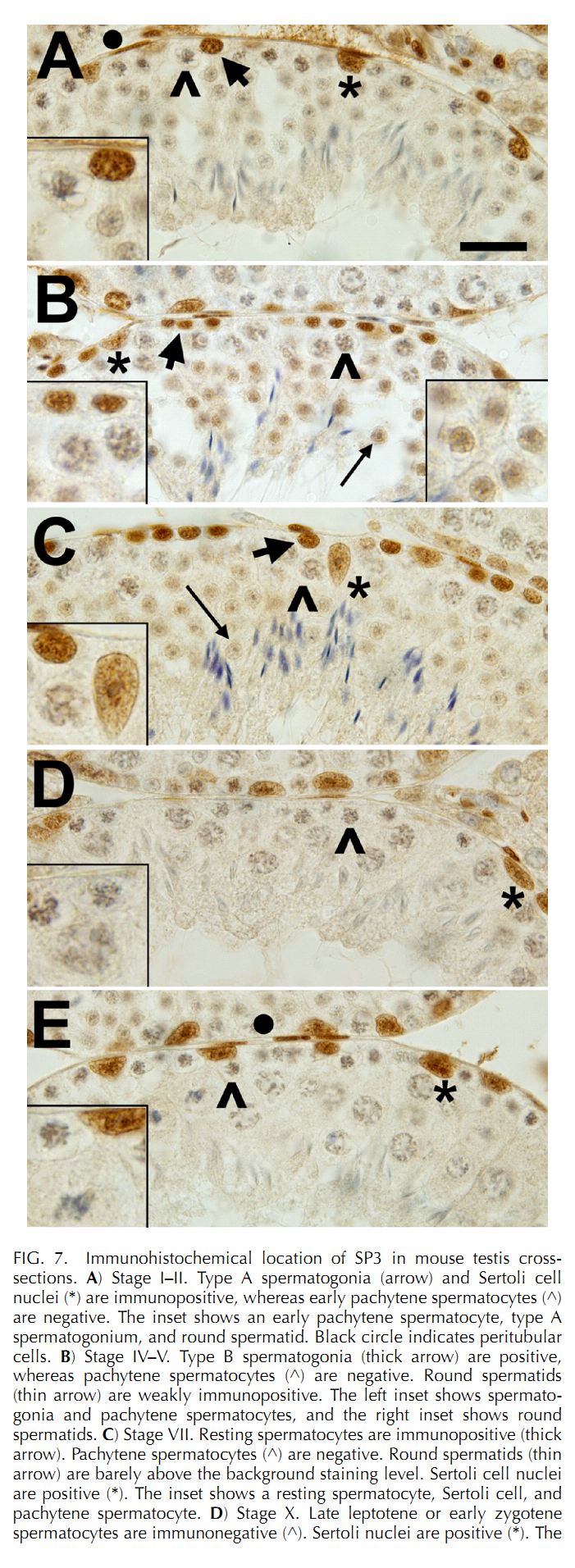
1. Abstract Because of their prominent roles in regulation of gene expression, it is important to understand how levels of Krupple-like transcription factors SP1 and SP3 change in germ cells during spermatogenesis. Using ... Because of their prominent roles in regulation of gene expression, it is important to understand how levels of Krupple-like transcription factors SP1 and SP3 change in germ cells during spermatogenesis. Using immunological techniques, we found that both factors decreased sharply during meiosis. SP3 declined during the leptotene-to-pachytene transition, whereas SP1 fell somewhat later, as spermatocytes progressed beyond the early pachytene stage. SP3 reappeared for a period in round spermatids. For Sp1, the transition to the pachytene stage is accompanied by loss of the normal, 8.2-kb mRNA and appearance of a prevalent, 8.8-kb variant, which has not been well characterized. We have now shown that this pachytene-specific transcript contains a long, unspliced sequence from the first intron and that this sequence inhibits expression of a reporter, probably because of its many short open-reading frames. A second testis-specific Sp1 transcript in spermatids of 2.4 kb also has been reported previously. Like the 8.8-kb variant, it is compromised translationally. We have confirmed by Northern blotting that the 8.8-, 8.2-, and 2.4-kb variants account for the major testis Sp1 transcripts. Thus, the unexpected decline of SP1 protein in the face of continuing Sp1 transcription is explained, in large part, by poor translation of both novel testis transcripts. As part of this work, we also identified five additional, minor Sp1 cap sites by 5' rapid amplification of cDNA ends, including a trans-spliced RNA originating from the Glcci1 gene.
PMID: [18417714]
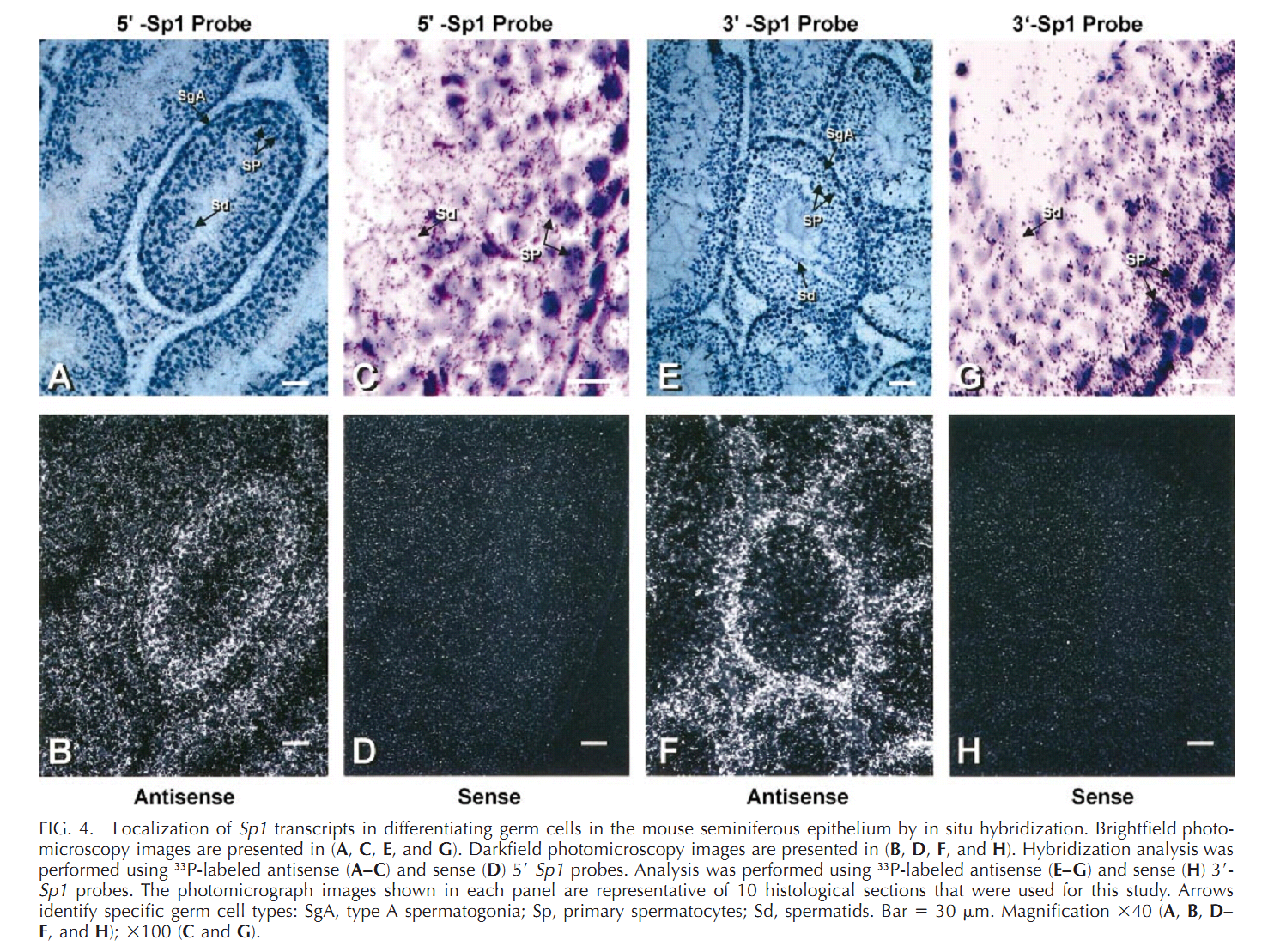
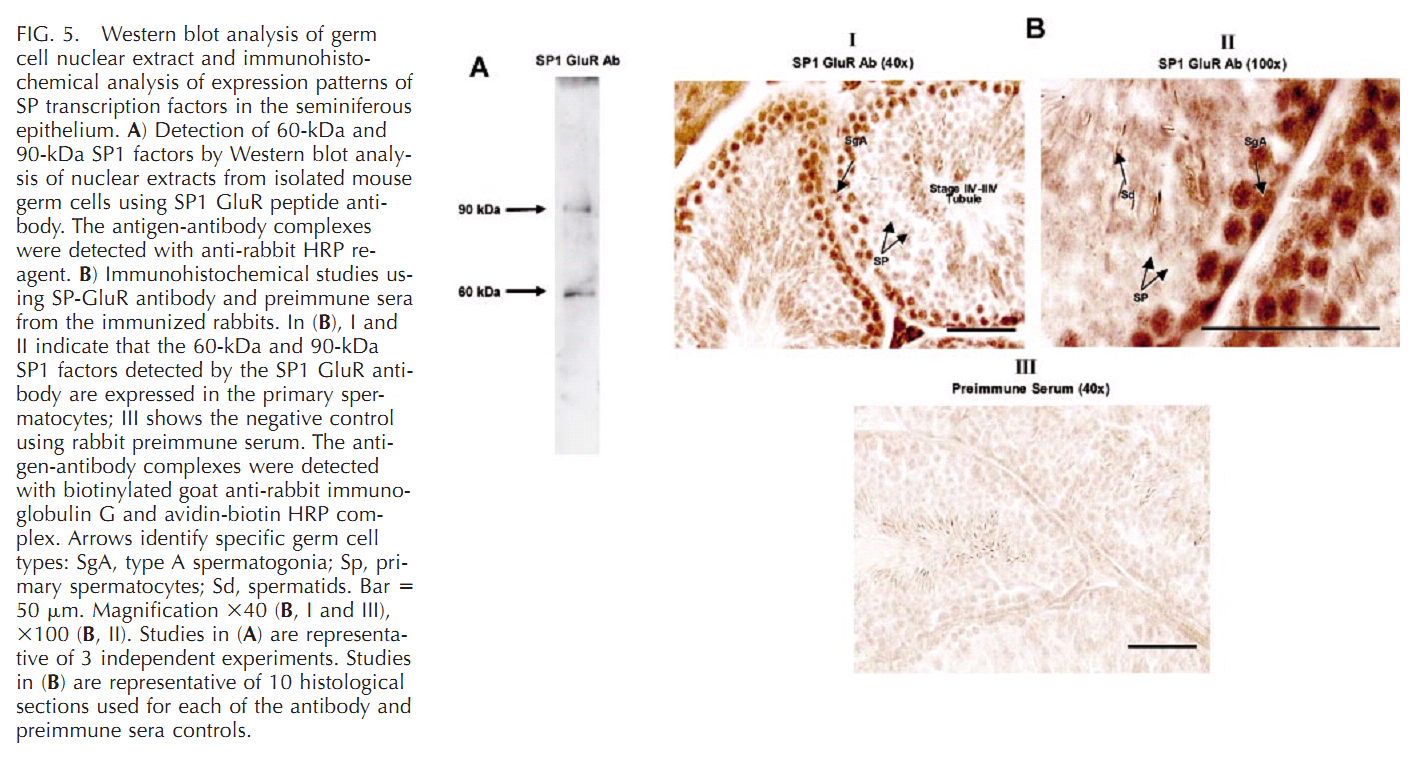
2. Abstract The SP family of zinc-finger transcription factors are important mediators of selective gene activation during embryonic development and cellular differentiation. SP-binding GC-box domains are common cis-regulatory elements present in the promoters of ... The SP family of zinc-finger transcription factors are important mediators of selective gene activation during embryonic development and cellular differentiation. SP-binding GC-box domains are common cis-regulatory elements present in the promoters of several genes expressed in a developmentally specific manner in differentiating mouse germ cells. Four Sp1 cDNAs were isolated from a mouse pachytene spermatocyte cDNA library and characterized by DNA sequence analysis. Northern blot studies revealed that these cDNAs corresponded to 3 full-length Sp1 transcripts (4.1, 3.7, and 3.2 kilobases [kb]) and an additional 1.4-kb 5'-truncated Sp1 transcript that are temporally expressed during spermatogenesis. Quantitative real-time polymerase chain reaction studies verified that the highest levels of Sp1 transcript expression of 4.1, 3.7, and 3.2 kb occur in the primary spermatocytes. The spatial and temporal expression patterns of these Sp1 transcripts and their encoded 60-kDa and 90-kDa SP1 proteins were demonstrated using in situ hybridization and immunohistochemical analyses. To assess the transcriptional properties of these SP1 transcription factors, SP-deficient Drosophila SL2 cells were stably transfected with the respective Sp1 cDNA expression vectors and cotransfected with either Ldh2, Ldh3, or Creb promoter/luciferase reporter constructs. The levels of SP-mediated luciferase expression observed depended on the structure of the glutamine-rich transactivation domains and the number of GC-box elements present in the respective promoters. The alterations observed in germ cells in the patterns of expression of the Sp1 transcripts encoding the 60-kDa and 90-kDa SP1 isoforms suggest that these SP1 factors may be involved in mediating stage-specific and cell type-specific gene expression during mouse spermatogenesis.
PMID: [15601926]
W. Ma, G. C. Horvath, M. K. Kistler and W. S. Kistler (2008) Expression patterns of SP1 and SP3 during mouse spermatogenesis. Biol Reprod 79(2): 289-300. PMID: [18417714]
W. Ma, G. C. Horvath, M. K. Kistler and W. S. Kistler (2008) Expression patterns of SP1 and SP3 during mouse spermatogenesis. Biol Reprod 79(2): 289-300. PMID: [18417714]
K. Thomas, D. Y. Sung, J. Yang, K. Johnson, W. Thompson, C. Millette, J. McCarrey, A. Breitberg, R. Gibbs and W. Walker (2005) Identification, characterization, and functional analysis of sp1 transcript variants expressed in germ cells during mouse spermatogenesis. Biol Reprod 72(4): 898-907. PMID: [15601926]
K. Thomas, D. Y. Sung, J. Yang, K. Johnson, W. Thompson, C. Millette, J. McCarrey, A. Breitberg, R. Gibbs and W. Walker (2005) Identification, characterization, and functional analysis of sp1 transcript variants expressed in germ cells during mouse spermatogenesis. Biol Reprod 72(4): 898-907. PMID: [15601926]
The SP family of zinc-finger transcription factors are important mediators of selective gene activation during embryonic development and cellular differentiation. SP-binding GC-box domains are common cis-regulatory elements present in the promoters of several genes expressed in a developmentally specific manner in differentiating mouse germ cells. SP1 may be involved in mediating stage-specific and cell type-specific gene expression during mouse spermatogenesis.
Complex name
Subunits(UniProt IDs)
Functional comment
SP1-E2F1 complex
Q61501 O89090
ReactomeID: R-MMU-6807505 RNA polymerase II transcribes snRNA genes